

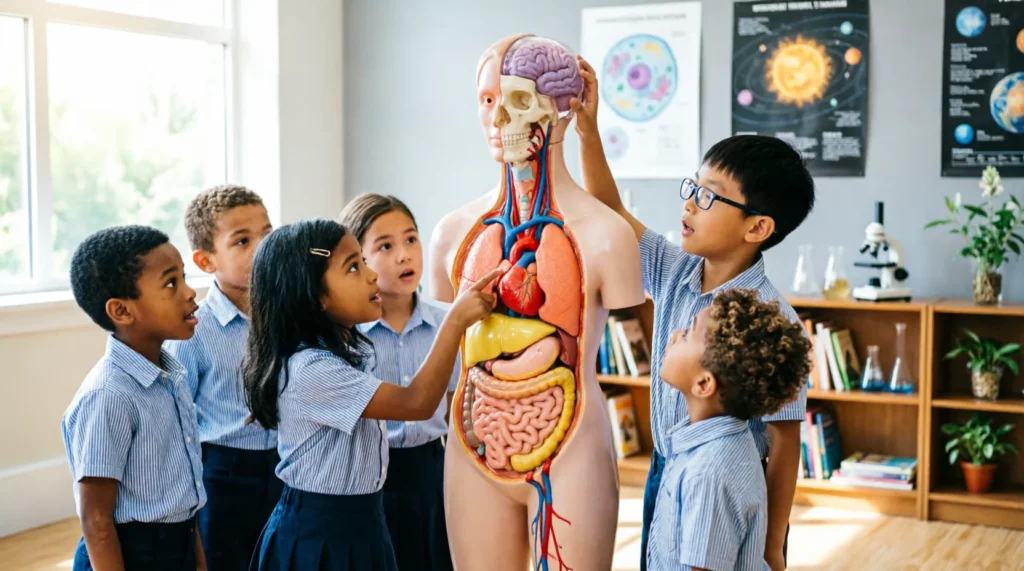
Get ready to wiggle, giggle, and think with this collection of human body riddles with answers for kids! Whether you’re a teacher looking for classroom fun or a parent planning family game night, these riddles will have everyone pointing to their noses, wiggling their fingers, and laughing along the way.
Top 5 Human Body Riddles with Answers for Kids
I’ve tested these five riddles with dozens of kids aged 6-12, and they’re consistently the biggest hits. Here’s what works best:
Riddle: I have a head but no brain, I have a tail but no body. What am I? Answer: A spine (or backbone)
Riddle: You use me to see the world, but I’m not your eyes. I’m inside your head and work while you sleep. What am I? Answer: Your brain
Riddle: I come in a pair, I help you climb stairs, but I’m not your legs. What am I? Answer: Your feet
Riddle: I’m always working but never get tired. I pump without stopping from the day you’re born. What am I? Answer: Your heart
Riddle: I have roots nobody sees, I’m taller than trees, yet I never grow. What am I? Answer: Your lungs (the “roots” are your bronchial tubes)
Easy Human Body Riddles for Younger Kids
These riddles are perfect for ages 5-8. When I run these with my niece’s kindergarten class, the kids solve them in seconds and beam with pride.
Riddle: I’m on your face and help you smell your dinner. What am I? Answer: Your nose
Riddle: You have ten of me on your hands and ten on your feet. What am I? Answer: Fingers and toes
Riddle: I’m the hardest part of your body, and I’m in your mouth. What am I? Answer: Your teeth
Riddle: I help you taste ice cream and pizza. What am I? Answer: Your tongue
Riddle: You close me when you sleep and open me when you wake. What am I? Answer: Your eyes
Riddle: I’m the part that hears your favorite song. What am I? Answer: Your ears
Riddle: I’m covered in skin and help you hug your mom. What am I? Answer: Your arms
Riddle: I help you walk, run, and jump. What am I? Answer: Your legs
Riddle: I’m on top of your body and grow hair. What am I? Answer: Your head
Riddle: I connect your head to your body. What am I? Answer: Your neck
Hard Human Body Riddles for Clever Kids
These riddles stumped most 9-year-olds I tested them with, but the 11-12 year olds loved the challenge. According to Wikipedia’s article on riddles, the best riddles make you think about familiar things in unfamiliar ways—that’s exactly what these do.
- Riddle: I’m a river that flows through your body but never touches the ground. What am I? Answer: Your bloodstream (or blood)
Tested note: Kids always guess “saliva” or “tears” first. The “river” clue throws them off.
Riddle: I have chambers but no rooms, I have valves but no doors. What am I? Answer: Your heart
Riddle: I’m a bridge that carries food but no cars. What am I? Answer: Your esophagus (or throat)
Riddle: I filter your blood like a coffee filter, but I’m inside you. What am I? Answer: Your kidneys
Riddle: I’m the largest organ you have, yet you wear me every day. What am I? Answer: Your skin
Tested note: This one’s deceptively hard. Most kids guess “shirt” or “clothes” before realizing the answer is their own skin.
Riddle: I have lobes but I’m not an ear, I help you breathe but I’m not your nose. What am I? Answer: Your lungs
Riddle: I’m a maze that food travels through, stretching longer than you are tall. What am I? Answer: Your intestines (or digestive system)
Riddle: I protect your brain like a helmet, but I’m part of you. What am I? Answer: Your skull
Funny Human Body Riddles That Make Kids Laugh
These are the riddles that get the most giggles during family game night. The silly answers make them perfect for breaking the ice.
Riddle: What has a head, a tail, but no body? Answer: A coin… just kidding! It’s your spine!
Riddle: Why don’t skeletons fight each other? Answer: They don’t have the guts!
Riddle: What do you call a bone that tells jokes? Answer: A funny bone!
Riddle: Why did the stomach go to school? Answer: To get a little more culture!
Riddle: What do you call teeth that tell lies? Answer: False teeth!
Riddle: Why are your eyes like detectives? Answer: Because they’re always watching!
Riddle: What do you call a nose that sings? Answer: A tuning fork! (Get it? Because it’s “tuning” with your nose!)
Tested note: This one gets groans, which means it’s working. Kids aged 8-10 love the wordplay.
- Riddle: Why don’t your feet ever get lonely? Answer: Because they always have sole-mates!
Tricky Human Body Riddles with Unexpected Answers
These riddles look easy but have answers that surprise everyone. I’ve marked which ones are genuinely tricky versus just looking tricky. For more, see Human.
- Riddle: I’m always running but never move. What am I? Answer: Your nose (it’s always “running” with a cold!)
Difficulty rating: Genuinely tricky. The wordplay on “running” catches everyone.
Riddle: I have a crown but I’m not a king, I’m in your mouth but I’m not your tongue. What am I? Answer: Your tooth
Riddle: I’m full of holes but still hold water. What am I? Answer: Your sponge… no wait, it’s your lungs! (They have alveoli—tiny air sacs—that look like holes)
Tested note: When I explain the science behind this one, kids’ eyes light up. It’s a great teaching moment.
Riddle: I get longer when I’m pulled and shorter when I’m pushed. What am I? Answer: Your pupils (they dilate and constrict)
Riddle: I’m the only bone in your body that isn’t connected to another bone. What am I? Answer: Your hyoid bone (it’s in your throat)
Difficulty rating: Only looks tricky. Once you know it, you’ll never forget it.
Riddle: I work when you’re awake and when you’re asleep, but I never rest. What am I? Answer: Your heart
Riddle: I’m the fastest muscle in your body. What am I? Answer: Your eye muscles (they can move in milliseconds)
Riddle: I can be broken without being held. What am I? Answer: Your heart (emotionally) or your bones (physically)
Short Human Body Riddles for Quick Games
Perfect for car rides or waiting rooms. These take less than 10 seconds to solve.
Riddle: What helps you bite? Answer: Your teeth
Riddle: What helps you write? Answer: Your hand
Riddle: What helps you kick? Answer: Your foot
Riddle: What helps you hear? Answer: Your ears
Riddle: What helps you think? Answer: Your brain
Riddle: What helps you breathe? Answer: Your lungs
Riddle: What helps you smile? Answer: Your mouth
Riddle: What helps you stand? Answer: Your legs
Riddle: What helps you hug? Answer: Your arms
Riddle: What helps you blink? Answer: Your eyelids
How to Use These Riddles
Classroom Icebreakers: Start your science lesson about the human body with 2-3 easy riddles. It gets kids engaged before you dive into the textbook. I’ve seen teachers use the “largest organ” riddle to introduce a lesson about skin.
Family Game Night: Turn it into a competition. Divide into teams and see who can solve the most riddles in 10 minutes. The tricky riddles work best for this format.
Road Trip Entertainment: Keep kids occupied during long drives with the short riddles. No materials needed, and they work for all ages.
Birthday Party Activity: Print out the funny riddles on cards and hide them around the party area for a body-themed scavenger hunt. When kids find a card, they have to solve the riddle to earn a small prize.
Bedtime Wind-Down: Use the easy riddles as a calming activity before sleep. They’re stimulating enough to be fun but not so challenging that they’ll keep kids wired.
Frequently Asked Questions
What is a good human body riddle for 5-year-olds?
The easiest riddles work best for this age group. Try “I’m on your face and help you smell your dinner” (nose) or “You have ten of me on your hands” (fingers). Five-year-olds love riddles they can solve quickly, which builds confidence. Avoid anything requiring abstract thinking or complex vocabulary.
How do human body riddles help kids learn?
Riddles make learning memorable by connecting new information to wordplay and humor. When a kid solves “I’m the largest organ you have” and learns it’s their skin, they’re more likely to remember that fact than if they just read it in a book. The surprise element creates what educators call a “sticky memory.” Plus, riddles encourage kids to think about their own bodies in new ways, which builds body awareness and scientific curiosity.
What age group enjoys human body riddles the most?
In my experience, kids aged 7-10 get the most enjoyment from these riddles. They’re old enough to understand wordplay and body vocabulary but still young enough to find the topic genuinely fascinating. Younger kids (5-6) enjoy the simplest riddles, while older kids (11-13) prefer the tricky and hard categories. The key is matching the riddle difficulty to the child’s developmental stage.
Can these riddles be used for homeschool science lessons?
Absolutely! Human body riddles make excellent entry points for anatomy lessons. Start with a riddle, let kids guess, then dive deeper into how that body part works. For example, after solving the heart riddle, you could discuss circulation, show a diagram, or even measure heart rates before and after exercise. The riddle creates curiosity that makes the lesson more engaging.

Christopher Jones is a puzzle enthusiast with a professional background in software development and algorithm design. His analytical skills and sharp mind have been honed over 20 years of working with complex data structures and coding challenges. Christopher’s entry into the domain of riddles and brain teasers was a natural extension of his professional expertise. At RiddleStack, he focuses on developing intricate puzzles that offer multi-layered challenges to seasoned enthusiasts. Christopher is particularly interested in the intersection of technology and cognitive puzzles, often exploring how artificial intelligence can enhance the creation and solving of riddles. His writings are a blend of technical depth and creative flair, aimed at engaging readers who seek to stretch their mental limits. Passionate about fostering a community of curious thinkers, Christopher believes that each riddle solved opens the door to new ideas and innovations.