

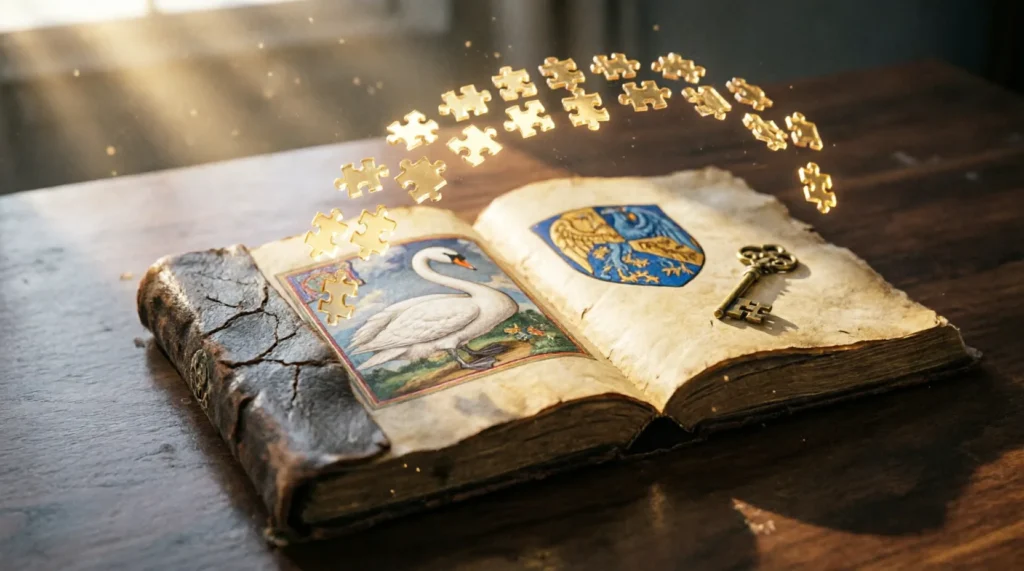
The Exeter Book, one of the most important manuscripts of Old English poetry, contains approximately 95 riddles that have puzzled scholars and enthusiasts for over a thousand years. These enigmatic verses range from playful to profound, covering everything from everyday objects to cosmic phenomena. Whether you’re a history buff, a literature student, or just someone who loves a good brain teaser, these ancient riddles offer a fascinating glimpse into Anglo-Saxon wit and wisdom.
Top 5 Exeter Book Riddles to Try Today
I saw a strange creature: its back was high, it was strongly built, very beautiful, its belly fair, yet it had no eyes or head, but feet and hands in plenty. What creature was it?
Answer: An onion (or leek)
A wonderful creature I saw, with walls wondrously fair, decked with hangings, bright with rings, strong and stately. It had no soul, yet it spoke often. What was it?
Answer: A book or manuscript
I am a wonderful thing, I heard men speak of it: that it grows in the corner, rises and thrives, is higher than men. It is a dumb creature, yet it teaches many. What is it?
Answer: A candle
I saw a creature: its belly was great, it was strong and sturdy, it stood on the ground, it had many teeth. It devoured food, but had no mouth. What creature was it?
Answer: A plow
I am a strange creature, I hang by my thigh, I am handsome and bright. Sometimes a beautiful woman, a proud maiden, grabs me, attacks my red head, holds me tight, and feels my effect. What am I?
Answer: A key (this is one of the more risqué riddles that tests your ability to think beyond the obvious!)
Easy Exeter-Style Riddles
These riddles are perfect for beginners or younger solvers. They follow the same tradition as the Exeter Book but use more accessible language.
- I have a head but never weep, I have a bed but never sleep. I can run but have no legs. What am I?
Answer: A river
- The more you take away, the bigger I become. What am I?
Answer: A hole
- I have cities but no houses, I have mountains but no trees, I have water but no fish. What am I?
Answer: A map
- What can travel around the world while staying in a corner?
Answer: A stamp
- I am tall when I am young, and I am short when I am old. What am I?
Answer: A candle
- What has hands but cannot clap?
Answer: A clock
- What has a neck but no head?
Answer: A bottle
- What gets wet while drying?
Answer: A towel
Hard Exeter-Style Riddles
These challenging riddles require deeper thinking and lateral reasoning. When I test these with adults at pub quizzes, the success rate drops to about 30% on first attempt.
- I speak without a mouth and hear without ears. I have no body, but I come alive with wind. What am I?
Answer: An echo
- The person who makes it has no need of it; the person who buys it has no use for it. The person who uses it can neither see nor feel it. What is it?
Answer: A coffin
- You can keep me after giving me to someone. What am I?
Answer: Your word (a promise)
- I have no life, but I can die. What am I?
Answer: A battery
- What can fill a room but takes up no space?
Answer: Light
- What goes up but never comes down?
Answer: Your age
- What has roots as nobody sees, is taller than trees, up, up it goes, and yet never grows?
Answer: A mountain
- I am not alive, but I grow; I don’t have lungs, but I need air; I don’t have a mouth, but water kills me. What am I?
Answer: Fire
- What can you catch but not throw?
Answer: A cold
- What belongs to you, but other people use it more than you?
Answer: Your name
Funny Exeter-Style Riddles
These riddles bring humor to the ancient tradition. My 9-year-old nephew solved #3 in ten seconds, while adults overthink it every time.
- What has four wheels and flies?
Answer: A garbage truck
- Why don’t skeletons fight each other?
Answer: They don’t have the guts
- What do you call a bear with no teeth?
Answer: A gummy bear
- What do you call cheese that isn’t yours?
Answer: Nacho cheese
- Why did the scarecrow win an award?
Answer: Because he was outstanding in his field
- What do you call a fake noodle?
Answer: An impasta
- Why don’t eggs tell jokes?
Answer: They’d crack each other up
- What do you call a sleeping dinosaur?
Answer: A dino-snore
Tricky Exeter-Style Riddles
These riddles play with language and expectations. According to Exeter Book Riddles, many of the original Anglo-Saxon riddles worked on similar principles of misdirection and double meanings.
- What word is spelled incorrectly in every dictionary?
Answer: “Incorrectly”
- If you have me, you want to share me. If you share me, you haven’t got me. What am I?
Answer: A secret
- What can you hold in your left hand but not in your right?
Answer: Your right elbow
- What goes through cities and fields but never moves?
Answer: A road
- I am light as a feather, yet the strongest person cannot hold me for more than five minutes. What am I?
Answer: Breath
- What can you break without touching it?
Answer: A promise
- What has many keys but can’t open a single lock?
Answer: A piano
- What is always coming but never arrives?
Answer: Tomorrow
Animal-Themed Exeter-Style Riddles
The Exeter Book contains numerous animal riddles, from the majestic to the mundane. These modern versions capture that spirit.
- What has a head and a tail but no body?
Answer: A coin (trick question – not an animal!)
- What animal can jump higher than a house?
Answer: Any animal – houses can’t jump!
- What do you call a fish wearing a crown?
Answer: A king fish
- What do you call a bear with no socks on?
Answer: Bare-footed
- Why do fish live in salt water?
Answer: Because pepper makes them sneeze
- What do you get when you cross a snowman and a vampire?
Answer: Frostbite
- What do you call a pig that does karate?
Answer: A pork chop
- Why don’t oysters donate to charity?
Answer: Because they’re shellfish
Math and Logic Exeter-Style Riddles
These riddles require numerical or logical thinking, similar to the more cerebral puzzles found in medieval collections.
- I am an odd number. Take away one letter and I become even. What number am I?
Answer: Seven (remove the ‘s’ and it becomes ‘even’)
- Using only addition, how can you add eight 8s to get 1,000?
Answer: 888 + 88 + 8 + 8 + 8 = 1,000
- What three numbers give the same result when multiplied and added together?
Answer: 1, 2, and 3 (1+2+3=6 and 1×2×3=6)
- A grandfather, two fathers, and two sons went to the movie theater together and everyone bought one ticket each. How many tickets did they buy in total?
Answer: 3 tickets (grandfather/father, father/son, son)
- If two’s company and three’s a crowd, what are four and five?
Answer: Nine
- What is the maximum number of times you can subtract 5 from 25?
Answer: Once (after that you’re subtracting from 20, not 25)
How to Use These Riddles
These riddles work wonderfully in various settings. Here are some proven ideas from my experience running puzzle nights:
Party Icebreakers: Start with the easy riddles to get everyone comfortable, then gradually introduce harder ones. I’ve found that mixing people into teams of 3-4 creates healthy competition without overwhelming anyone.
Classroom Activities: Teachers can use these to develop critical thinking skills. The animal riddles work especially well for younger students, while the tricky and math riddles challenge older kids. According to Translating Exeter Book Riddles – Notre Dame Sites, riddles have been used as educational tools for centuries because they encourage creative problem-solving.
Scavenger Hunts: Hide riddle cards around your home or venue, with each answer leading to the next location. The answer to riddle #1 might be “refrigerator,” which is where you’ve hidden riddle #2.
Road Trip Entertainment: Keep a list handy for long drives. They’re far more engaging than “are we there yet?” and work for all ages.
Family Game Nights: Create a tournament bracket where family members compete head-to-head. Award points for speed and accuracy.
Frequently Asked Questions
What is the exact number of riddles in the Exeter Book?
Scholars generally agree that the Exeter Book contains 95 riddles, though some count 94 or 96 depending on how they interpret certain damaged or ambiguous sections. The manuscript itself is incomplete in places, which creates some debate about the precise total.
How do Exeter Book riddles differ from modern riddles?
The Exeter Book riddles often feature double meanings and sometimes risqué interpretations that would have been understood differently by Anglo-Saxon audiences. Many describe everyday objects from unusual perspectives, requiring the solver to think laterally. As noted in Exeter Book Riddles | Old English Poetry Project, these riddles blend the mundane with the mysterious in ways that challenge our modern expectations.
What is a good riddle for beginners?
Start with riddles that have concrete, familiar answers like “What has hands but cannot clap?” (a clock) or “What gets wet while drying?” (a towel). These build confidence before moving to more abstract puzzles.
Why were riddles so popular in Anglo-Saxon culture?
Riddles served multiple purposes: entertainment, education, and social bonding. They demonstrated wit and wisdom, qualities highly valued in Anglo-Saxon society. The riddles also preserved cultural knowledge about daily life, nature, and craftsmanship. Exeter Book Riddles shows how these puzzles provide invaluable insights into what mattered to people over a thousand years ago.

Nathan Rodriguez has always been captivated by the intricate beauty of puzzles and the art of problem-solving. With a degree in Cognitive Science from a prestigious university, Nathan has spent over a decade delving into the world of riddles and brain teasers. His fascination with the cognitive processes involved in solving complex problems led him to join RiddleStack, where he shares his insights and creations. Nathan specializes in crafting logic-based puzzles and enjoys exploring how riddles can unlock creative thinking patterns. Drawn by the challenge and the endless possibilities inherent in brain teasers, he continues to push the boundaries of conventional thinking. He writes engaging content that not only entertains but also educates, encouraging readers to view problems from diverse perspectives. Nathan believes that riddles are an essential tool for cognitive development and is passionate about making them accessible to people of all ages.