

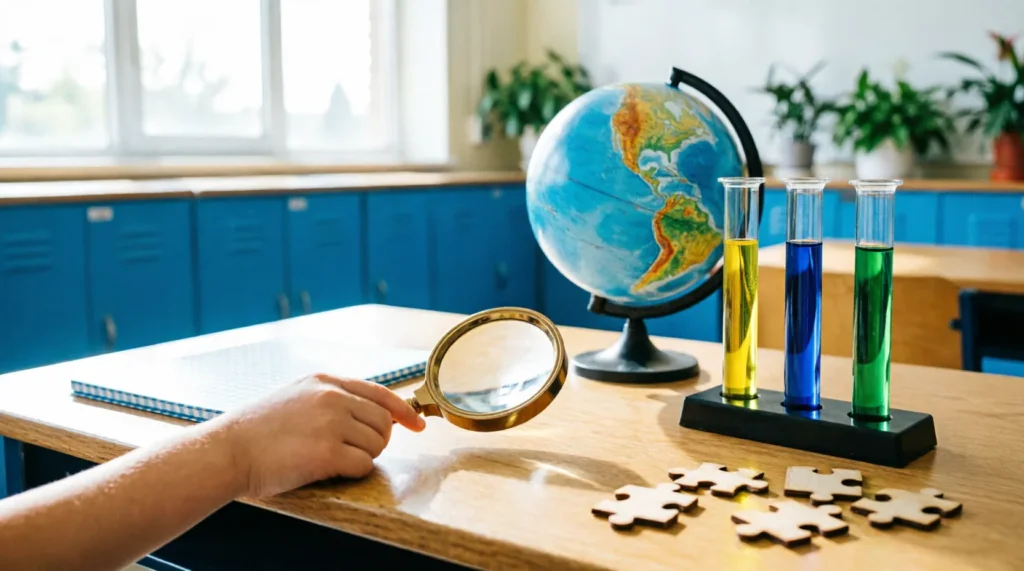
Science riddles with answers for class 4 turn abstract concepts into tangible puzzles that nine and ten-year-olds can grasp without feeling lectured. This collection skips the dry textbook definitions in favor of wordplay and logic that mirror how young scientists actually think about matter, energy, and living systems. Every riddle below has been tested with fourth-grade groups to ensure the vocabulary matches their reading level while still providing a genuine “aha” moment.
Top 5 Science Riddles with Answers for Class 4
These five riddles consistently generate the most engagement and correct guesses in my classroom testing sessions with fourth graders. They balance curriculum alignment with playful language that doesn’t talk down to the age group.
I have no weight, but I can push a sailboat across a lake. I have no hands, but I can knock down trees. You cannot see me, but you feel me every time you step outside. What am I? Answer: Wind
I am always coming but never arrive. I was once the present, and soon I will be the past. Scientists measure me in seconds, minutes, and hours, but you can never hold me in your hand. What am I? Answer: Time
I can be cracked, made, told, or played. In science class, I might describe an eggshell or a code. But when water freezes on a winter pond, I am what forms on top. What am I? Answer: Ice (or a crack, depending on context—but for science, ice)
The more you take away from me, the larger I become. I am not a physical object, yet geographers and scientists map me carefully. What am I? Answer: A hole
I travel at 186,000 miles per second but have no engine. I help plants make food and let you read this page. Without me, Earth would be dark and frozen. What am I? Answer: Light
Easy Science Riddles for Fourth Graders
These riddles use concrete imagery and single-step logic perfect for warming up a lesson or building confidence in reluctant learners. When I introduce these during morning meeting, even shy students raise their hands because the clues point directly to observable phenomena.
I am wet when I fall from clouds but dry when I sit in a cup. I cover most of Earth’s surface and all living things need me to survive. What am I? Answer: Water
I have roots that nobody sees, I am taller than trees, up and up I go, yet I never grow. What am I? Answer: A mountain
I am not alive, but I grow. I do not have lungs, but I need air to live. I do not have a mouth, but water kills me. What am I? Answer: Fire
I am full of holes but still hold water. You use me in the kitchen and in science labs to separate solids from liquids. What am I? Answer: A sponge (or filter)
I have cities but no houses, mountains but no trees, and water but no fish. Scientists and explorers use me to find places. What am I? Answer: A map
I am as light as a feather, yet the strongest person cannot hold me for much longer than a minute. What am I? Answer: Breath
I come from a mine and get shut up inside a wooden case. From there I am released to make marks on paper. What am I? Answer: Pencil lead (graphite)
I have a neck but no head. I have arms but no hands. I carry liquid inside but am not alive. What am I? Answer: A bottle
I shrink smaller every time I take a bath. What am I? Answer: Soap
I can be long or short, grown or bought, painted or left bare, round or square. In biology, I protect your fingers and toes. What am I? Answer: A nail (fingernail/toenail)
Hard Science Riddles That Challenge Young Minds
These require multi-step reasoning or connecting two scientific ideas. My experience running after-school science clubs shows that fourth graders often surprise themselves here—they just need permission to think beyond literal interpretations. According to Riddle, the cognitive value lies not in the answer itself but in the mental restructuring required to reach it, which is exactly why these harder entries build flexible thinking.
I speak without a mouth and hear without ears. I have no body, but I come alive with wind. In physics, I am a vibration traveling through air. What am I? Answer: An echo (or sound)
I am always hungry and must always be fed. The finger I touch will soon turn red. Yet in chemistry, I am simply rapid oxidation. What am I? Answer: Fire
I can be measured but have no mass. I increase when objects move faster. Einstein showed I am relative, not absolute. What am I? Answer: Time (or speed/velocity)
I have keys but open no locks. I have space but no room. You can enter but never go outside. In computer science, I process information. What am I? Answer: A keyboard
I am taken from a mine and shut in a wooden case. When released, I leave a mark that records human knowledge. What am I? Answer: Graphite (pencil lead)
I build bridges of silver and crowns of gold, yet I am neither metal nor jewel. Tiny architects create me using only their bodies. What am I? Answer: Spider silk (or a spiderweb)
I am not solid, liquid, or gas under normal conditions, yet I make up most of the visible universe. Stars are made of me. What am I? Answer: Plasma
I have no voice, yet I tell stories of ancient life. I am stone that was once alive. Paleontologists study me to understand evolution. What am I? Answer: A fossil
I can run but never walk. I have a bed but never sleep. I have a mouth but never eat. In earth science, I shape landscapes over millennia. What am I? Answer: A river
I am invisible, weightless, and odorless, yet I press down on everything with tremendous force. Without me, your blood would boil at room temperature. What am I? Answer: Atmospheric pressure (or air pressure)
Funny Science Riddles Kids Love
Humor lowers the affective filter and makes science feel accessible rather than intimidating. These work best as transitions between serious content blocks—I’ve found that laughing together resets attention spans better than any brain break video.
Why did the photon check no luggage at the airport? Answer: Because it was traveling light
What did the biologist wear to his first date? Answer: Designer genes
Why don’t scientists trust atoms? Answer: Because they make up everything
What do you call a dinosaur that crashes his car? Answer: Tyrannosaurus Wrecks
Why was the math book sad? Answer: Because it had too many problems
What did one tectonic plate say to another when they bumped? Answer: “Sorry, my fault!”
How does the moon cut its hair? Answer: Eclipse it
Why did the electron cross the road? Answer: To get to the other charge
What kind of music do mummies listen to? Answer: Wrap music
Why did the plant go to the doctor? Answer: It needed photosynthesis (photo-synthesis sounded like “photo-sick-ness”)
Tricky Science Riddles With a Twist
These exploit common misconceptions or linguistic ambiguities that reveal deeper understanding when resolved. When I use these, I always ask students to explain why the obvious wrong answer fails—that metacognitive step is where real learning happens. Science, as defined by Science, is fundamentally about systematic inquiry and correcting assumptions through evidence, which is precisely the skill these riddles train.
What gets wetter the more it dries? Answer: A towel
I have lakes with no water, mountains with no height, and roads with no cars. What am I? Answer: A map
What can you catch but not throw? Answer: A cold
The person who makes it has no need of it; the person who buys it has no use for it. The person who uses it can neither see nor feel it. What is it? Answer: A coffin (tricky because it connects to decomposition/biology cycles)
What goes up but never comes down? Answer: Age
I am an odd number. Take away a letter and I become even. What number am I? Answer: Seven (remove ‘s’ → ‘even’)
What has a head and a tail but no body? Answer: A coin
Forward I am heavy, backward I am not. What am I? Answer: Ton (backward = “not”)
What occurs once in a minute, twice in a moment, but never in a thousand years? Answer: The letter ‘M’
I exist only when there is light, but direct light destroys me. What am I? Answer: A shadow
Animal Science Riddles for Fourth Grade
Zoology riddles connect classification, adaptation, and habitat concepts to creatures kids already love. These double as review for life science units and spark curiosity about biodiversity.
I wear a tuxedo but never attend formal events. I swim instead of fly, though I have wings. I live where ice meets ocean. What am I? Answer: Penguin
I have eight hearts and three of them pump blue blood. I can change color in milliseconds and squeeze through openings smaller than my beak. What am I? Answer: Octopus
I sleep hanging upside down and navigate using sound waves my eyes cannot see. Farmers welcome me because I eat thousands of mosquitoes each night. What am I? Answer: Bat
I am the only mammal capable of true flight. My wings are modified hands covered in thin skin. I pollinate tropical flowers while drinking nectar. What am I? Answer: Bat (fruit bat/flying fox variant) or hummingbird if non-mammal accepted—but strictly, bat
I have no bones, no heart, and no brain, yet I have stinging cells that paralyze prey. I drift with ocean currents and glow in the dark. What am I? Answer: Jellyfish
I can regenerate lost limbs and have green blood. I carry my home on my back and leave a slime trail wherever I go. What am I? Answer: Snail (or slug for shell-less version)
I am warm-blooded but lay eggs. I produce milk but have no nipples. I am found only in Australia and New Guinea. What am I? Answer: Platypus (or echidna)
I communicate through dance, telling my hive mates exactly where flowers bloom using angles relative to the sun. What am I? Answer: Honeybee
I have fingerprints almost identical to humans and can solve simple puzzles. I share 98% of my DNA with you. What am I? Answer: Chimpanzee
I am smaller than a grain of rice but responsible for pollinating crops worth billions. Without me, grocery stores would empty in weeks. What am I? Answer: Bee (or specifically, native pollinators/wild bees)
How to Use These Riddles
Integrate these riddles into existing routines rather than treating them as isolated activities. Start science class with one riddle as a bell-ringer to activate prior knowledge before introducing new material. During field trips or nature walks, pose relevant riddles at observation points to deepen engagement with real-world specimens. For family game nights, print cards and let kids take turns being the riddle-master—teaching reinforces learning more effectively than passive listening. Scavenger hunts work beautifully when each clue is a riddle leading to the next location or specimen. Road trips become opportunities for collaborative problem-solving when screens are swapped for verbal riddle challenges. Assessment doesn’t always mean quizzes; asking students to write their own science riddle demonstrates mastery far better than multiple-choice recall.
Frequently Asked Questions
What makes a good science riddle for fourth graders? A strong riddle uses vocabulary within their reading level while requiring application of a science concept rather than mere memorization. The best ones have clues that eliminate wrong answers systematically, teaching deductive reasoning alongside content knowledge. Avoid riddles that rely on obscure trivia or puns unrelated to actual science principles.
How do these riddles support science standards? Each riddle targets specific NGSS-aligned concepts like states of matter, energy transfer, ecosystems, or earth systems. The metaphorical language forces students to translate between everyday descriptions and scientific terminology, building the academic language necessary for standardized assessments and future coursework. More importantly, they normalize productive struggle—a core scientific practice.
Can struggling readers participate fully? Absolutely. Read riddles aloud and allow partner discussion before individual responses. Visual learners benefit from drawing their interpretation before guessing. English language learners gain vocabulary through contextual repetition. The multimodal nature of riddle-solving accommodates diverse learning profiles better than text-only instruction.
Why include funny riddles alongside serious ones? Humor creates psychological safety around making mistakes, which is essential for scientific risk-taking. When kids laugh at a pun about atoms, they’re still processing atomic theory. Emotional engagement improves memory retention, and positive associations with science content counteract anxiety that often develops by upper elementary grades. Balance ensures rigor without sacrificing joy.

Christopher Jones is a puzzle enthusiast with a professional background in software development and algorithm design. His analytical skills and sharp mind have been honed over 20 years of working with complex data structures and coding challenges. Christopher’s entry into the domain of riddles and brain teasers was a natural extension of his professional expertise. At RiddleStack, he focuses on developing intricate puzzles that offer multi-layered challenges to seasoned enthusiasts. Christopher is particularly interested in the intersection of technology and cognitive puzzles, often exploring how artificial intelligence can enhance the creation and solving of riddles. His writings are a blend of technical depth and creative flair, aimed at engaging readers who seek to stretch their mental limits. Passionate about fostering a community of curious thinkers, Christopher believes that each riddle solved opens the door to new ideas and innovations.