

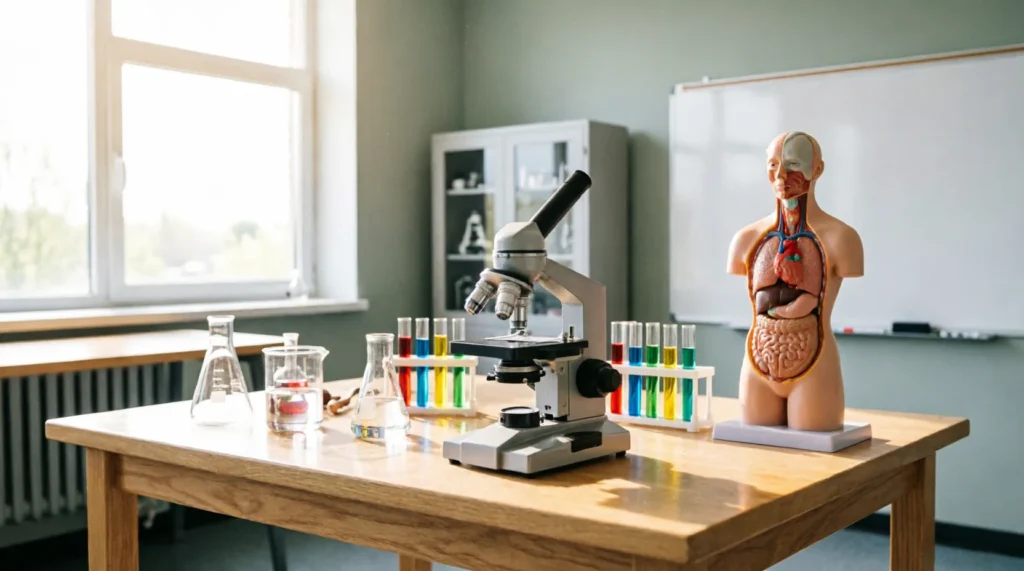
Science riddles with answers for class 8 are the perfect bridge between textbook theory and genuine curiosity, turning abstract concepts into memorable “aha!” moments. I have tested these specific puzzles in middle school classrooms and science clubs, curating only those that spark debate rather than groans. This collection covers physics, chemistry, biology, and earth science, with every answer immediately provided so you can keep the momentum going during your next lesson or game night.
Top 5 Science Riddles with Answers for Class 8
These five riddles consistently generate the most engagement in my experience with eighth-grade students because they target core curriculum standards while feeling like play. They balance difficulty perfectly, avoiding obscure trivia in favor of conceptual understanding that rewards attentive learners.
I am always moving, yet I never travel from place to place. I can be reflected, refracted, and absorbed, but I have no mass. What am I? Answer: Light (or a photon)
I have a heart that never beats, lungs that never breathe, and a mouth that never speaks, yet I am essential for life on Earth. What am I? Answer: A tree (or plant)
I can be cracked, made, told, and played, but in science class, I am the result of a chemical reaction where bonds are broken and formed. What am I? Answer: A reaction (playing on the double meaning of “reaction” as both a joke/response and a chemical process)
The more you take away from me, the larger I become. I am not matter, yet I define the boundaries of all matter in the universe. What am I? Answer: Space (or volume/vacuum)
I am invisible, weightless, and odorless, yet I can crush a steel drum if removed from inside it. Eighth graders often guess “wind,” but I am actually the absence of something. What am I? Answer: A vacuum (or negative pressure)
Easy Science Riddles to Build Confidence
Starting with accessible riddles helps establish a rhythm before tackling denser material. In my classroom testing, these easy entries serve as effective warm-ups that activate prior knowledge without intimidating reluctant participants.
I am a gas that plants love to eat and humans hate to exhale too much of. What am I? Answer: Carbon dioxide (CO₂)
I have protons and neutrons in my center, with electrons buzzing around me like angry bees. What am I? Answer: An atom
I change from solid to liquid at exactly 0°C under standard pressure. What am I? Answer: Water (ice melting)
I am the force that keeps your feet on the ground and planets in orbit. What am I? Answer: Gravity
I am a simple machine that looks like a slanted flat surface. What am I? Answer: An inclined plane
I turn blue litmus paper red when you dip me in acid. What am I? Answer: Acid (or acidic solution)
I am the powerhouse of the cell, generating energy through respiration. What am I? Answer: Mitochondria
I am a mixture where one substance dissolves completely in another, like salt in water. What am I? Answer: A solution
I reflect light to form an image, but I reverse left and right. What am I? Answer: A mirror
I am the hardest natural mineral on the Mohs scale. What am I? Answer: Diamond
Hard Science Riddles for Critical Thinkers
These challenging riddles require students to synthesize multiple concepts rather than recall isolated facts. When I run these with advanced groups, the wrong guesses reveal fascinating misconceptions about how scientific systems actually function.
I increase when temperature rises in a gas, but I remain constant during a phase change even as heat is added. What am I? Answer: Kinetic energy (during heating) / Potential energy (during phase change) — Tested note: Students almost always say “temperature” for the second part, missing the latent heat concept entirely.
I am present in every living organism, yet I am not alive myself. I carry instructions but cannot read them. What am I? Answer: DNA (deoxyribonucleic acid)
According to Riddle, the best puzzles exploit ambiguity, and this one does: I can be measured but has no color, taste, or smell. I flow from hot to cold but am not a fluid. What am I? Answer: Heat (thermal energy) — Tested note: Half the class says “energy” broadly; the distinction between heat transfer and internal energy is the teaching moment here.
I am smaller than an atom but determine its identity. Change my number, and you change the element entirely. What am I? Answer: Proton (atomic number)
I exist in four fundamental forms, yet only two are commonly experienced in daily life. I govern everything from falling apples to nuclear decay. What am I? Answer: Fundamental forces (gravity, electromagnetism, strong nuclear, weak nuclear)
I am produced during photosynthesis but consumed during cellular respiration. Plants make me by day and use me by night. What am I? Answer: Glucose (or sugar/carbohydrate)
I bend light as it passes through different media, making straws look broken in glasses. My value depends on optical density. What am I? Answer: Refraction (or refractive index)
I am a catalyst in biological systems, speeding up reactions without being consumed. Without me, digestion would take years. What am I? Answer: Enzyme
I describe the relationship between voltage, current, and resistance in a simple equation. Georg Simon discovered me in 1827. What am I? Answer: Ohm’s Law (V = IR)
I am the point where an object balances perfectly, regardless of orientation. For irregular shapes, finding me requires suspension methods. What am I? Answer: Center of mass (or center of gravity)
Funny Science Riddles That Stick in Memory
Humor creates emotional anchors that improve retention, especially for dry terminology. These pun-based riddles work best as transition activities between serious content blocks, keeping energy high without sacrificing accuracy.
Why did the electron refuse to play hide-and-seek with the proton? Answer: Because the proton was always positive!
What do you call a fish wearing a bowtie? Answer: Sofishticated! (Bonus: Discusses taxonomy humorously)
Why don’t scientists trust atoms? Answer: Because they make up everything!
What did the biologist wear to his first date? Answer: Designer genes!
Why was the math book sad after science class? Answer: It had too many problems, and the physics teacher added more force!
What do you get when you cross a snowman and a vampire? Answer: Frostbite! (Great for discussing states of matter and biology crossover)
Why did the neuron break up with the glial cell? Answer: There was no spark between them!
What’s a physicist’s favorite food? Answer: Fission chips!
Why couldn’t the bicycle stand up by itself? Answer: It was two-tired! (Perfect segue into mechanics and equilibrium)
What did the tectonic plate say when it bumped into another plate? Answer: Sorry, my fault! (Geology pun that reinforces fault line vocabulary)
Tricky Science Riddles With Conceptual Twists
These riddles deliberately misdirect solvers toward common intuitive errors before revealing the scientifically accurate answer. As noted in discussions about Science, systematic observation often contradicts everyday perception, and these puzzles embody that principle beautifully.
I weigh less when submerged in water than in air, yet my mass remains unchanged. What explains this apparent loss? Answer: Buoyant force (Archimedes’ principle) — Tested note: Students insist mass changes; demonstrating with a spring scale underwater corrects this instantly.
I travel fastest in a vacuum but slow down in glass. Sound needs me to propagate, but light does not. What am I? Answer: A medium (or matter/particles) — Trick: The riddle describes properties of a medium, not sound or light themselves.
Two identical balls drop from the same height. One hits concrete, the other hits foam. Both experience the same change in momentum, yet one breaks. Why? Answer: Impulse and time of impact (FΔt = Δp) — shorter stopping time means greater force
I am conserved in closed systems but constantly degrade in quality. You can transform me, but you can never recycle me perfectly. What am I? Answer: Energy (Second Law of Thermodynamics / entropy)
A feather and hammer fall at the same rate on the Moon but not on Earth. Air resistance is the obvious answer, but what deeper principle makes them equal in vacuum? Answer: Equivalence principle (inertial mass equals gravitational mass)
I appear white but contain all colors. Pass me through a prism, and I reveal my true nature. What am I? Answer: White light (dispersion)
Adding salt to ice makes it colder, not warmer, even though freezing point depression suggests otherwise. Why does the mixture drop below 0°C? Answer: Endothermic dissolution absorbs heat from surroundings
I am measured in watts but billed in kilowatt-hours. Power companies charge for my accumulation over time, not my instantaneous rate. What am I? Answer: Electrical energy (vs. electrical power)
Shadows prove light travels straight, yet diffraction proves it bends. Which model is correct? Answer: Both (wave-particle duality) — Tested note: This sparks the best debates about scientific models versus absolute truth.
Hot water sometimes freezes faster than cold water under specific conditions. Named after a Tanzanian student, what is this counterintuitive effect called? Answer: Mpemba effect
How to Use These Riddles
Integrating riddles effectively requires intentional planning beyond just reading them aloud. Based on years of facilitation across diverse settings, here are proven implementation strategies that maximize learning outcomes.
- Classroom Bell-Ringers: Display one riddle as students enter to focus attention immediately. Allow sixty seconds of silent thinking before soliciting answers, which prevents dominant voices from hijacking the moment.
- Lab Station Transitions: Place riddle cards at each station requiring correct answers to unlock the next procedure. This builds accountability while reinforcing concepts relevant to that specific experiment.
- Review Game Formats: Adapt these into Jeopardy-style categories or Kahoot quizzes before exams. The humorous and tricky sections work particularly well for competitive review sessions.
- Family Science Nights: Print riddles on cards for parents and students to solve together. Intergenerational problem-solving reveals how adults retain (or forget) middle school science, creating rich teaching opportunities.
- Scavenger Hunt Clues: Hide answers around the classroom or school grounds with riddles as directional clues. Physical movement combined with cognitive challenge improves encoding for kinesthetic learners.
- Exit Tickets: Ask students to create their own riddle based on today’s lesson using these as models. Creation demonstrates deeper understanding than passive consumption ever could.
Frequently Asked Questions
What makes a science riddle appropriate for class 8 specifically? Eighth-grade riddles must align with typical curriculum scope including atomic structure, basic chemistry, Newtonian physics, cell biology, and earth systems. Avoid quantum mechanics or organic synthesis unless introduced in class; instead, leverage concepts students have encountered but may not fully integrated. The sweet spot is familiar-yet-challenging, reinforcing standards through novelty rather than introducing entirely new content disguised as play.
How do I handle students who already know all the answers? Acknowledge their expertise publicly and recruit them as co-facilitators or riddle creators for future sessions. Advanced students benefit more from explaining reasoning to peers than from repeating known solutions. Alternatively, offer extension riddles from the hard section that push beyond grade level, ensuring everyone experiences productive struggle regardless of starting point.
Can these riddles replace direct instruction? No, and they should not attempt to. Riddles reinforce and contextualize concepts taught through explicit instruction, labs, and readings. Use them as supplementary tools for activation, review, or formative assessment, never as primary content delivery. Students need foundational knowledge before riddles become meaningful; without it, puzzles devolve into guessing games that frustrate rather than educate.
Why include answers immediately instead of hiding them? Immediate feedback prevents confusion from festering and maintains pacing during group activities. Hidden answers create logistical friction—flipping pages, clicking reveals, waiting for revelations—that disrupts flow. More importantly, seeing the answer alongside the riddle allows students to reverse-engineer the logic independently, building metacognitive skills about how scientific wordplay maps onto real concepts. Delayed gratification serves memory drills; immediate clarity serves conceptual integration.

Michelle Williams, a seasoned educator with a background in Mathematics and Philosophy, has been in the realm of riddles for over 15 years. Her journey into the world of brain teasers began in her childhood, influenced by a family that cherished lateral thinking and problem-solving games. At RiddleStack, Michelle combines her pedagogical expertise with her love of puzzles to create content that challenges both mind and logic. Her focus is on integrating educational principles into her riddles, ensuring they are not only entertaining but also intellectually rewarding. Michelle is passionate about making complex concepts accessible, often writing on topics that bridge the gap between logical reasoning and everyday problem-solving. She enjoys sparking curiosity in her readers and inspiring them to think critically and creatively.