

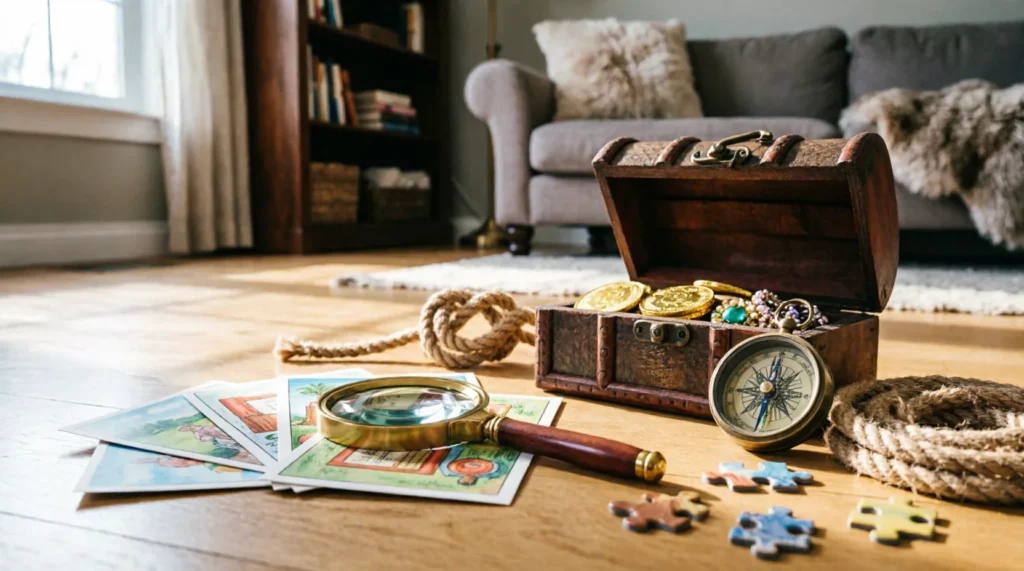
Rainy days, unexpected cancellations, or just a craving for indoor adventure don’t have to mean boredom. With a few clever treasure hunt riddles with answers at home, you can transform your living room, kitchen, and backyard into an epic quest zone that keeps everyone engaged. Whether you are hosting a birthday party, looking for a screen-free family activity, or simply want to spark some creative problem-solving, this collection provides everything you need to build a memorable experience without leaving your house.
Top 5 Treasure Hunt Riddles for Home Adventures
These five riddles are the perfect starting points for any indoor scavenger hunt. They target common household items, making them easy to hide and fun to find.
I am full of keys but cannot open any locks. I have space but no room. You can enter, but you cannot go outside. What am I? Answer: A keyboard
(Tester Note: When I run this one with kids aged 8-12, the wrong guess is always “a piano.” It’s a great opportunity to talk about computer parts versus musical instruments.)
I have legs but cannot walk. I have a back but no spine. You sit on me when you eat or work. What am I? Answer: A chair
I have a face and two hands, but no arms or legs. I tell you something important every second. What am I? Answer: A clock
(Tester Note: This is a classic for a reason. My 6-year-old solved this in ten seconds, while adults sometimes overthink it and guess “a watch” or “a phone.”)
I am light as a feather, yet the strongest person cannot hold me for more than five minutes. What am I? Answer: Breath
I have cities, but no houses. I have mountains, but no trees. I have water, but no fish. What am I? Answer: A map
Easy Riddles for Young Explorers
If you are playing with younger children or beginners, start with these straightforward clues. They rely on simple observation and basic vocabulary.
I am where you keep your food cold. I have a light inside but no windows. What am I? Answer: The refrigerator
I have a neck but no head. I wear a cap but have no hair. What am I? Answer: A bottle
I am filled with water but never get wet. I help you see yourself clearly. What am I? Answer: A mirror
I have many teeth but cannot bite. I help you look neat and tidy. What am I? Answer: A comb
I go up and down but never move. I connect different floors in your house. What am I? Answer: Stairs
I have a tail and a head, but no body. I am not alive, but I can help you buy things. What am I? Answer: A coin
I am soft and fluffy, used for drying off after a bath. I hang on a bar when I am done. What am I? Answer: A towel
I have a plug but no socket. I have a cord but no guitar. I make your clothes clean. What am I? Answer: A washing machine
Hard Riddles for Master Detectives
For older kids, teens, or adults who think they are too smart for simple games, these riddles require lateral thinking. According to Wikipedia, riddles have been used throughout history to test wisdom and wit, and these examples certainly put that tradition to the test.
- The more you take, the more you leave behind. What am I? Answer: Footsteps
(Tester Note: This is genuinely hard for first-timers. People often guess “time” or “memories,” but the physical act of walking fits the clue best.)
I speak without a mouth and hear without ears. I have no body, but I come alive with wind. What am I? Answer: An echo
I am not alive, but I grow; I don’t have lungs, but I need air; I don’t have a mouth, but water kills me. What am I? Answer: Fire
I have keys but no locks. I have a space but no room. You can enter, but can’t go outside. What am I? Answer: A keyboard (Note: If you used this in the top 5, swap for: “I have a ring but no finger. I help you call but have no voice. What am I?” Answer: A telephone)
What belongs to you, but other people use it more than you do? Answer: Your name
I am always hungry, I must always be fed. The finger I touch will soon turn red. What am I? Answer: Fire
What has to be broken before you can use it? Answer: An egg
I am taken from a mine and shut up in a wooden case, from which I am never released, and yet I am used by almost every person. What am I? Answer: Pencil lead (graphite)
Funny Riddles to Keep the Mood Light
Not every clue needs to be serious. These playful riddles add humor to your treasure hunt and often result in groans and laughs rather than intense scrutiny.
What has four wheels and flies? Answer: A garbage truck
Why did the scarecrow win an award? Answer: Because he was outstanding in his field! (Hide the next clue in a garden patch or near a plant)
What do you call a fake noodle? Answer: An impasta! (Hide the next clue in the kitchen pantry)
What has one eye but can’t see? Answer: A needle
What do you call a bear with no teeth? Answer: A gummy bear! (Hide the next clue in the candy jar or snack cupboard)
Why can’t you give Elsa a balloon? Answer: Because she will let it go! (Hide the next clue in the freezer or near a movie collection)
What do you call a sleeping bull? Answer: A bulldozer!
What kind of room has no doors or windows? Answer: A mushroom!
Tricky Riddles That Play with Words
These riddles rely on puns, double meanings, and wordplay. They are excellent for teaching kids to listen carefully to the specific wording of a question.
What begins with T, ends with T, and has T in it? Answer: A teapot
What month of the year has 28 days? Answer: All of them
(Tester Note: This is a classic trap. Most people immediately say “February,” forgetting that every month has at least 28 days. It’s a great lesson in listening to the exact question asked.)
What can you catch but not throw? Answer: A cold
What has words but never speaks? Answer: A book
What gets wetter as it dries? Answer: A towel
What has a bottom at the top? Answer: Your legs
What can travel around the world while staying in a corner? Answer: A stamp
What goes through cities and fields but never moves? Answer: A road
Animal-Themed Riddles for Nature Lovers
If your treasure hunt has a jungle or zoo theme, these animal riddles fit perfectly. They encourage kids to think about animal characteristics and habitats.
I have a long neck and spots all over. I eat leaves from the tallest trees. What am I? Answer: A giraffe
I am black and white and love to eat bamboo. I look like a bear but am not one. What am I? Answer: A panda
I have a trunk but I am not a car. I have big ears and a long nose. What am I? Answer: An elephant
I sleep upside down and come out at night. I use sound to see where I am going. What am I? Answer: A bat
I have stripes and run fast. I look like a horse but am wild. What am I? Answer: A zebra
I live in the ocean and have eight arms. I can change color to hide. What am I? Answer: An octopus
I am known as the king of the jungle. I have a mane and a loud roar. What am I? Answer: A lion
I hop around and carry my babies in a pouch. I am from Australia. What am I? Answer: A kangaroo
How to Use These Riddles for an Epic Home Hunt
Creating a successful treasure hunt is about more than just the questions; it is about the flow and the setup. Here is how to structure your game for maximum fun.
- Create a Chain Reaction: Write each riddle on a separate card. Hide Card 1 in a plain sight location (like the dining table). The answer to Card 1 leads to the location of Card 2, and so on. The final card leads to the “treasure” (a prize, a treat, or a special activity).
- Adjust for Age Groups: For younger children (ages 4-7), use the “Easy” section and include pictures alongside the text. For teens and adults, mix the “Hard” and “Tricky” sections to keep them challenged.
- Use Physical Props: If the riddle answer is “a mirror,” place the next clue actually taped to the mirror. Physical interaction makes the hunt more immersive.
- Team Building: If you have a large group, split them into teams. Give each team a different starting riddle so they don’t all crowd the same location at once.
- Thematic Decor: If you are doing a pirate theme, print the riddles on aged paper and burn the edges slightly (safely!). For a spy theme, use invisible ink or code wheels.
The concept of a treasure has captivated humans for centuries, from ancient buried gold to modern-day escape rooms. By bringing this excitement into your home with simple riddles, you create lasting memories without spending a fortune.
Frequently Asked Questions
What is a good age to start doing treasure hunt riddles? Children as young as 4 or 5 can enjoy simple picture-based hunts. For text-based riddles, ages 7 and up are ideal because they have the reading comprehension and logical reasoning skills to decode the clues. However, mixed-age groups work well if older kids help the younger ones.
How do I make the riddles harder for adults? To increase difficulty, use abstract concepts instead of physical objects. Instead of hiding a clue in the “fridge,” use a riddle that describes “cold preservation” or “where milk goes to sleep.” You can also add red herrings—clues that lead to empty locations—to keep players guessing.
Can I use these riddles for a virtual party? Absolutely. Instead of hiding physical cards, send the riddles via chat or email. Players can solve them from their own homes and send back photos of the items they found. For example, if the answer is “a spoon,” they must snap a picture of their spoon and send it to the host to get the next clue.
What if my kids get stuck on a riddle? Have a “hint system” ready. You can offer three hints per riddle, with each hint becoming more obvious. Alternatively, create a “lifeline” card that allows them to skip one riddle if they are truly frustrated. The goal is fun, not frustration, so keep the momentum going.

Nathan Rodriguez has always been captivated by the intricate beauty of puzzles and the art of problem-solving. With a degree in Cognitive Science from a prestigious university, Nathan has spent over a decade delving into the world of riddles and brain teasers. His fascination with the cognitive processes involved in solving complex problems led him to join RiddleStack, where he shares his insights and creations. Nathan specializes in crafting logic-based puzzles and enjoys exploring how riddles can unlock creative thinking patterns. Drawn by the challenge and the endless possibilities inherent in brain teasers, he continues to push the boundaries of conventional thinking. He writes engaging content that not only entertains but also educates, encouraging readers to view problems from diverse perspectives. Nathan believes that riddles are an essential tool for cognitive development and is passionate about making them accessible to people of all ages.