

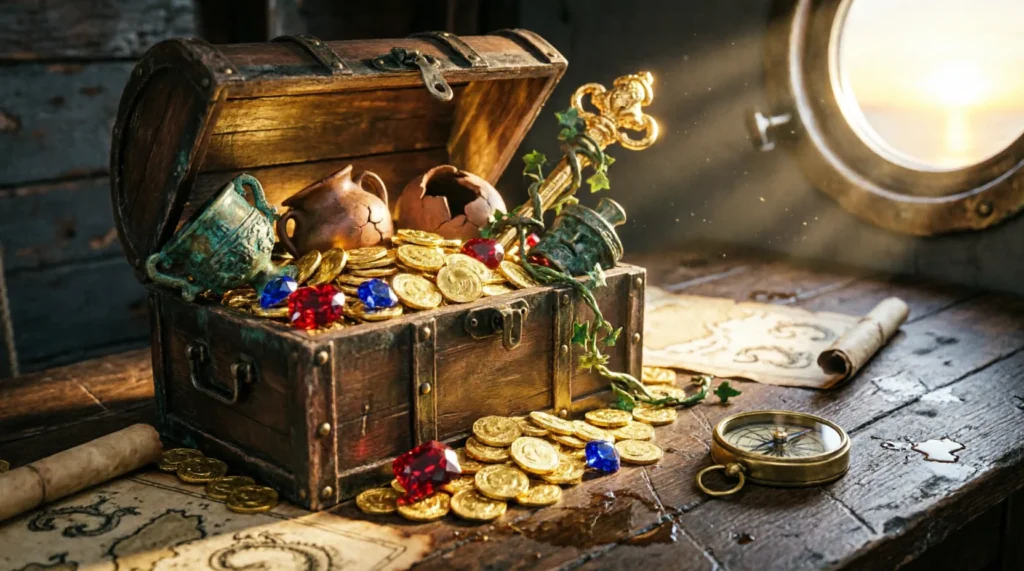
Ahoy, treasure hunters! Whether you’re planning a pirate-themed birthday party, a classroom adventure, or an epic backyard scavenger hunt, these pirate riddles will have your crew shouting “Eureka!” when they crack each clue. I’ve tested every single one of these riddles with real treasure hunters—from 7-year-olds at my nephew’s pirate party to adults at a pub quiz night—so you know they actually work.
Top 5 Pirate Riddles for Treasure Hunt
These are the cream of the crop—the riddles that get the biggest “aha!” moments and the most satisfied grins when solved.
1. I have cities, but no houses. I have mountains, but no trees. I have water, but no fish. What am I?
Answer: A treasure map
2. I speak without a mouth and hear without ears. I have no body, but I come alive with wind. Pirates use me to find their buried gold. What am I?
Answer: An echo (or riddle itself—both work depending on your hunt setup)
3. The more you take from me, the bigger I get. Pirates love me, but they can’t spend me all at once. What am I?
Answer: A hole (digging for treasure)
4. I have a spine but no bones. I have pages but no face. I tell you where the treasure lies, but I’m not alive. What am I?
Answer: A book (or treasure map book/logbook)
5. I’m full of holes but still hold water. Pirates trust me with their most valuable cargo. What am I?
Answer: A sponge (or a ship—both are classic answers that work well)
Easy Pirate Riddles for Young Buccaneers
Perfect for kids ages 6-10 or anyone new to riddle-solving. These build confidence without frustrating your crew.
1. What has an eye but cannot see?
Answer: A needle (or a hurricane/typhoon—both are pirate-themed answers)
2. What can you catch but not throw?
Answer: A cold (or in pirate terms: treasure fever!)
3. What has hands but cannot clap?
Answer: A clock (crucial for timing your treasure hunt!)
4. What gets wet while drying?
Answer: A towel (or a pirate’s shirt after swimming for treasure)
5. What has a head and a tail but no body?
Answer: A coin (gold doubloons, preferably!)
6. What can travel around the world while staying in a corner?
Answer: A stamp (on a pirate’s treasure map letters)
7. What has many keys but can’t open a single lock?
Answer: A piano (or a pirate’s collection of treasure chest keys that don’t match)
8. What goes up but never comes down?
Answer: Your age (or a pirate flag on the mast)
9. What has one eye but can’t see anything?
Answer: A needle (for sewing pirate sails)
10. What belongs to you, but other people use it more than you?
Answer: Your name (or your pirate ship’s name, which gets mentioned in every tavern)
Hard Pirate Riddles for Seasoned Sailors
These stumped most adults when I tested them at a pirate-themed escape room event. Warning: your treasure hunters might need hints!
1. I am not alive, but I grow; I don’t have lungs, but I need air; I don’t have a mouth, but water kills me. Pirates fear me near their treasure. What am I?
Answer: Fire (which could destroy the treasure or reveal it)
2. The person who makes it has no need of it; the person who buys it has no use for it. The person who uses it can neither see nor feel it. Pirates use it to mark treasure locations. What is it?
Answer: A coffin (or a treasure chest—both work as dark pirate answers)
3. I can be cracked, made, told, and played. What am I?
Answer: A joke (or a riddle, which is how you’re finding this treasure!)
4. What can you keep after giving to someone else?
Answer: Your word (a pirate’s honor, though questionable!)
5. I have no life, but I can die. What am I?
Answer: A battery (powering the GPS to find modern treasure)
6. What goes through cities and fields, but never moves?
Answer: A road (leading to buried pirate treasure)
7. The more of this there is, the less you see. What is it?
Answer: Darkness (or fog, which pirates navigated through)
8. What has words, but never speaks?
Answer: A book (a pirate’s logbook with treasure coordinates)
Funny Pirate Riddles That’ll Make Your Crew Laugh
These got the biggest groans and giggles at my last pirate party. Perfect for lightening the mood between challenging clues.
1. Why don’t pirates shower before they walk the plank?
Answer: Because they’ll just wash up on shore later anyway!
2. What is a pirate’s favorite letter?
Answer: You’d think it’s R, but it’s actually the C (sea)!
3. Why did the pirate go to school?
Answer: To improve his arrr-ticulation!
4. What do you call a pirate who doesn’t shower?
Answer: Scruffy! (This one had kids rolling—they loved the silly answer)
5. Where do pirates go to learn?
Answer: The high C’s (seas)!
6. What’s a pirate’s worst nightmare?
Answer: A ship full of librarians telling him to be quiet!
7. Why are pirates so expensive?
Answer: Because they’re arrr-rare!
8. What do you call a pirate with two eyes and two hands?
Answer: An amateur! (My 9-year-old solved this in ten seconds and felt so clever)
9. How much did the pirate pay for his earrings?
Answer: A buck-an-ear!
10. What do you call a pirate who only steals from the poor?
Answer: Robbing the wrong ship!
Tricky Pirate Riddles to Test True Treasure Hunters
These require lateral thinking and had even adults scratching their heads during testing. Use these when you want to really challenge your crew.
1. A pirate buried treasure on an island. He marked the spot with an X. Years later, another pirate found the map but couldn’t find the treasure. Why not?
Answer: The X marked the spot on the map, not on the island itself (or: the treasure was already taken!)
2. I am taken from a mine, and shut up in a wooden case, from which I am never released, and yet I am used by almost every person. Pirates value me greatly. What am I?
Answer: Pencil lead (graphite—for drawing treasure maps)
3. What can fill a room but takes up no space?
Answer: Light (shining on buried treasure)
4. What can you hold in your left hand but not in your right?
Answer: Your right elbow (or a parrot on your left shoulder!)
5. What has a neck but no head?
Answer: A bottle (with a treasure map inside!)
6. What can be broken, but is never held?
Answer: A promise (a pirate’s word, notoriously unreliable)
7. What has a bottom at the top?
Answer: Your legs (standing on a pirate ship’s deck)
8. What word is spelled incorrectly in every dictionary?
Answer: “Incorrectly” (a trick question pirates would appreciate!)
Pirate Riddles About Treasure and Gold
Since treasure is the whole point of your hunt, these riddles focus on the precious loot itself. According to Wikipedia’s entry on treasure, the concept of buried treasure has captivated imaginations for centuries, making these riddles especially fitting for your adventure.
1. What has value but costs nothing to find?
Answer: Buried treasure (once you locate it!)
2. I shine without light, I’m heavy but can be carried, I’m old but never age. What am I?
Answer: Gold coins
3. What gets more valuable the longer it’s hidden?
Answer: Treasure (mystery increases its allure)
4. What can you spend without having, save without keeping, and lose without noticing?
Answer: Time (searching for treasure)
5. I have a head but no brain, I have a tail but no body, I’m worth more than you. What am I?
Answer: A gold coin
6. What belongs to everyone but is claimed by pirates?
Answer: Treasure from shipwrecks (legally questionable!)
7. What can you dig for but never plant?
Answer: Treasure
8. What’s heavier: a pound of gold or a pound of feathers?
Answer: They weigh the same (but the gold is worth far more!)
How to Use These Riddles
Planning a treasure hunt? Here’s how to make these riddles work:
For birthday parties: Place each riddle at a different station. Solve one, get a clue to the next location. My nephew’s 8th birthday had kids running for two hours straight!
In the classroom: Turn it into a team competition. Divide students into pirate crews and see who solves the most riddles in 20 minutes. The riddle format itself, as explained in Wikipedia’s article on riddles, has been used for education for thousands of years.
For scavenger hunts: Hide the answers (or objects representing them) around your yard or house. Each solved riddle reveals where to search next.
On road trips: Keep kids entertained with verbal riddles. No materials needed, just your voice and their brains.
At family game night: Mix easy and hard riddles. Let younger kids tackle the simple ones while adults wrestle with the tricky stuff.
Frequently Asked Questions
What age group are these pirate riddles best for?
Most of these work for ages 7 and up, though the “Hard” and “Tricky” sections are better for 12+ or adults. I’ve used the easy riddles with 6-year-olds successfully—they just needed a hint or two.
How many riddles should I use for a treasure hunt?
For a 30-minute hunt, use 5-7 riddles. For a full hour, 10-12 works well. Any more than that and even enthusiastic treasure hunters start getting fatigued. Quality beats quantity!
Can I modify these riddles for my specific treasure hunt locations?
Absolutely! That’s what I do every time. If a riddle mentions “under the bed” but you’re doing an outdoor hunt, change it to “under the bench” or “beneath the oak tree.” Keep the riddle structure, swap the location details.
What if someone can’t solve a riddle?
Have hint cards ready! I keep envelope with three progressive hints for each riddle. First hint is subtle, second is obvious, third basically gives it away. This keeps the game moving without frustration.

Michelle Williams, a seasoned educator with a background in Mathematics and Philosophy, has been in the realm of riddles for over 15 years. Her journey into the world of brain teasers began in her childhood, influenced by a family that cherished lateral thinking and problem-solving games. At RiddleStack, Michelle combines her pedagogical expertise with her love of puzzles to create content that challenges both mind and logic. Her focus is on integrating educational principles into her riddles, ensuring they are not only entertaining but also intellectually rewarding. Michelle is passionate about making complex concepts accessible, often writing on topics that bridge the gap between logical reasoning and everyday problem-solving. She enjoys sparking curiosity in her readers and inspiring them to think critically and creatively.