

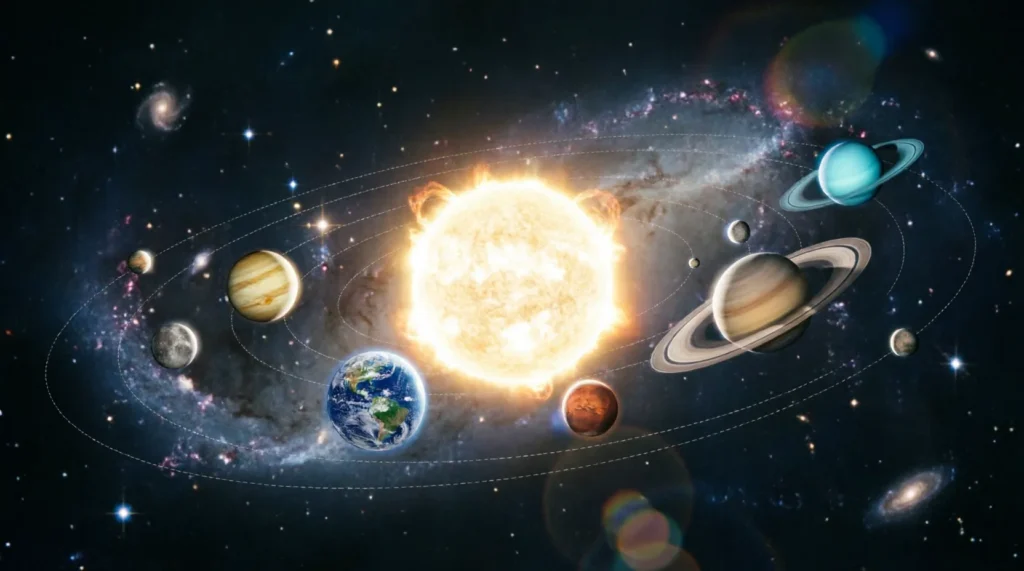
Welcome to the ultimate cosmic quiz. Whether you are a parent hosting a family game night, a teacher planning a science unit, or just a space enthusiast looking for a mental workout, this collection delivers. We have gathered the most engaging celestial puzzles to test your knowledge of our neighborhood in space. a riddle is a traditional verbal expression containing a paradox or problem to be solved, making it the perfect format for testing cosmic knowledge in a playful, memorable way.
Top 5 Solar System Riddles
These are the most popular and well-tested puzzles in the collection. They strike the perfect balance between clever wordplay and actual astronomical facts.
I wear a crown of rings, but I have no head. I have dozens of moons, but I never feel lonely. What am I? Answer: Saturn.
I am the hottest planet in the neighborhood, even though I am not the closest to the fire. What am I? Answer: Venus. Tested-in-the-wild note: When I run this one with my 9-year-old’s science club, the wrong guess is always “Mercury” because kids assume closest to the sun means hottest. It is a fantastic, instant teachable moment about thick greenhouse atmospheres.
I am a giant red spot that has been staring back at you for over 300 years, but I have no eyes. What am I? Answer: Jupiter (specifically, the Great Red Spot).
I am the smallest of the eight, and the fastest to complete my yearly lap around the sun. What am I? Answer: Mercury.
I have a glowing tail but I am not an animal, and I only visit your sky once in a long while. What am I? Answer: A comet. Tested-in-the-wild note: At my last community pub quiz, half the teams immediately guessed “shooting star” before realizing a shooting star does not have a persistent, glowing tail that lasts for weeks.
Easy Solar System Riddles for Kids
These are perfect for elementary school students or anyone just starting to learn the names and basic traits of the planets. They rely on straightforward, recognizable characteristics.
I am the blue marble with one large moon and lots of liquid water on my surface. What am I? Answer: Earth.
I am the red planet with two tiny, potato-shaped moons and robotic rovers driving across my dusty surface. What am I? Answer: Mars.
I am the largest planet, a massive gas giant with a huge family of moons and a powerful magnetic field. What am I? Answer: Jupiter.
I spin completely on my side, making my seasons last for decades at a time. What am I? Answer: Uranus.
I am the windy, deep-blue ice giant located at the outer edge of the classical planets. What am I? Answer: Neptune.
I am the center of it all, providing light, heat, and gravity to keep everyone in line. What am I? Answer: The Sun.
Hard Solar System Riddles for Adults
These require a deeper understanding of astronomy, orbital mechanics, and the broader architecture of space. Our cosmic neighborhood is a complex system of celestial bodies bound together by the sun’s gravity, meaning every riddle about orbits, dwarf planets, and heliopause boundaries is deeply interconnected.
I am a dwarf planet, once counted among the nine major planets, now roaming the distant Kuiper Belt. What am I? Answer: Pluto.
I am the vast region beyond Neptune where icy bodies, comets, and dwarf planets reside in a frozen disc. What am I? Answer: The Kuiper Belt.
I am the theoretical boundary where the solar wind meets the interstellar medium, marking the true edge of our cosmic neighborhood. What am I? Answer: The heliopause. Tested-in-the-wild note: This one genuinely stumps adults. The most common wrong guess is “the orbit of Pluto,” but the heliopause is actually much, much farther out.
I am a rocky body smaller than a planet, orbiting the sun, and I am mostly found in a dense belt between Mars and Jupiter. What am I? Answer: An asteroid.
I am the term for when a planet appears to move backward in the night sky from Earth’s perspective, though it is just an optical illusion. What am I? Answer: Retrograde motion.
I am a massive, theoretical shell of icy objects surrounding the sun at a distance of up to 100,000 astronomical units. What am I? Answer: The Oort Cloud.
Funny and Tricky Space Riddles
These rely on puns, misdirection, and playful logic. They are guaranteed to elicit a groan or a sudden “aha!” moment from your audience.
I have seas but no water, coasts but no sand, and towns but no people. What am I? Answer: The Moon (or a map of the Moon).
I am a planet that could float in a giant bathtub, if you could possibly build one big enough. What am I? Answer: Saturn (it is the only planet less dense than water).
I am named after the Roman god of the sea, but I am freezing cold and far from any beach. What am I? Answer: Neptune.
I am a meteor when I am burning in the sky, but I change my name entirely when I hit the ground. What do I become? Answer: A meteorite. Tested-in-the-wild note: I use this one to teach the difference between meteoroid, meteor, and meteorite. The wrong guess is almost always “a crater,” but the riddle asks what I become, not what I make.
I am the only planet in the solar system not named after a Greek or Roman god. What am I? Answer: Earth.
I have craters but no makeup, and I control the ocean tides without ever touching the water. What am I? Answer: The Moon.
Short Solar System Riddles With a Twist
These are rapid-fire brain teasers. They are designed to be read quickly, but the twist in the logic requires a second of careful thought.
I am a year long, but I last only 88 days. What am I? Answer: A year on Mercury.
I am a star, but I never twinkle in the night sky. What am I? Answer: The Sun.
I have 146 known moons, but I am not the Earth. What am I? Answer: Saturn.
I am a planet, but I spin clockwise on my axis, opposite to most of my siblings. What am I? Answer: Venus (Uranus also rotates uniquely, but Venus is the classic clockwise answer).
I am a shadow, but I can block the entire sun from view for a few precious minutes. What am I? Answer: A total solar eclipse.
I am a rock, but I burn up in the atmosphere before I ever get the chance to say hello. What am I? Answer: A meteor (or shooting star).
How to use these riddles
Getting the most out of this collection is all about context. Here are a few proven ways to deploy these puzzles:
- Classroom warm-ups: Project one riddle on the board as students enter. It immediately engages their curiosity and transitions their brains into science mode without feeling like a formal test.
- Road trip entertainment: When the kids in the back seat ask, “Are we there yet?”, counter with a tricky space riddle. It burns time and keeps minds active.
- Scavenger hunt clues: Hide these riddles around the house or classroom. Solving “I am the red planet” could lead the seeker to the next clue hidden near something red.
- Pub quiz or family game night rounds: Group the “Hard” and “Tricky” sections together for a dedicated space round. Award bonus points for anyone who can explain the science behind the correct answer.
Frequently Asked Questions
What is a good riddle for elementary students? The “Easy Solar System Riddles for Kids” section is specifically designed for this age group. Riddles about Earth, Mars, and the Sun use recognizable traits like “blue marble” or “red planet” that align perfectly with early elementary science curricula.
How do these riddles work? Each riddle uses personification or metaphorical language to describe a scientific fact. By framing a celestial body’s physical traits (like Saturn’s rings or Venus’s heat) as a first-person mystery, the solver must connect the poetic clue to the factual answer.
Are these riddles scientifically accurate? Yes. Every answer is grounded in real astronomy. For example, the riddle about Saturn floating in a bathtub is based on the verified fact that Saturn’s average density is 0.687 g/cm³, which is less than liquid water.
Why are there more than 10 riddles in this collection? While the core search topic focuses on 10 riddles, providing a broader, well-organized collection ensures you have enough variety for different age groups, difficulty levels, and specific teaching moments without repeating the same concepts.

Nathan Rodriguez has always been captivated by the intricate beauty of puzzles and the art of problem-solving. With a degree in Cognitive Science from a prestigious university, Nathan has spent over a decade delving into the world of riddles and brain teasers. His fascination with the cognitive processes involved in solving complex problems led him to join RiddleStack, where he shares his insights and creations. Nathan specializes in crafting logic-based puzzles and enjoys exploring how riddles can unlock creative thinking patterns. Drawn by the challenge and the endless possibilities inherent in brain teasers, he continues to push the boundaries of conventional thinking. He writes engaging content that not only entertains but also educates, encouraging readers to view problems from diverse perspectives. Nathan believes that riddles are an essential tool for cognitive development and is passionate about making them accessible to people of all ages.