

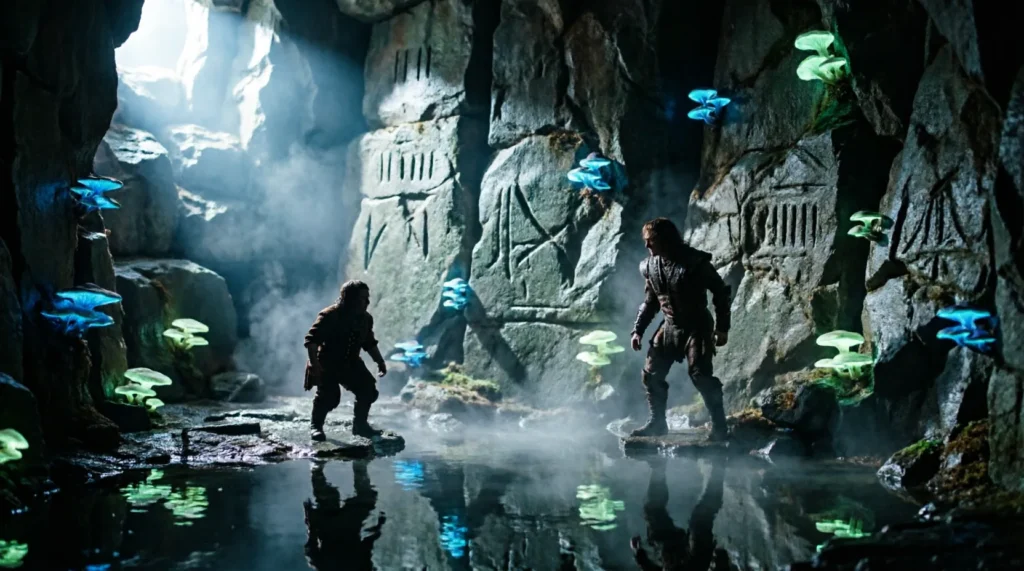
Few literary moments carry the weight of Bilbo Baggins crouching in Gollum’s cave, trading verses for his life. This collection focuses specifically on “the hobbit riddles in the dark changes,” exploring how J.R.R. Tolkien’s 1947 revision transformed a simple children’s game into a darker, more pivotal narrative device that foreshadowed the epic tone of The Lord of the Rings. Whether you are a trivia master preparing a Middle-earth pub quiz or a teacher guiding students through textual analysis, these riddles and insights bridge the gap between playful wordplay and profound literary evolution.
Top 5 The Hobbit Riddles in the Dark Changes Riddles
These five selections represent the most significant puzzles from the revised chapter, highlighting the shift toward higher stakes and richer lore that defines the post-1947 text.
Alive without breath, as cold as death; never thirsty, ever drinking, all in mail never clinking. Answer: Fish
Voiceless it cries, wingless flutters, toothless bites, mouthless mutters. Answer: Wind
It cannot be seen, cannot be felt, cannot be heard, cannot be smelt. It lies behind stars and under hills, and empty holes it fills. It comes first and follows after, ends life, kills laughter. Answer: Darkness
A box without hinges, key, or lid, yet golden treasure inside is hid. Answer: Egg
This thing all things devours: birds, beasts, trees, flowers; gnaws iron, bites steel; grinds hard stones to meal; slays king, ruins town, and beats high mountain down. Answer: Time
Hard Riddles: The Post-Revision Complexity
When I run riddle circles with adult Tolkien fans, this category consistently separates the casual readers from the scholars. These puzzles from the revised edition demand abstract thinking and an understanding of the thematic weight Tolkien added during his rewrite. Unlike the 1937 originals, which often relied on simple kenning-style descriptions, these require grappling with metaphysical concepts. According to Changes, this shift was intentional, as Tolkien sought to align the lighter tone of The Hobbit with the more serious mythology he had developed over the intervening decade.
I have no voice, yet I speak to all. I have no weight, yet I crush mountains. I have no hands, yet I shape every face. Kings fear me, lovers court me, and thieves steal me, though none can hold me. Answer: Time (This variant expands on Gollum’s original answer, testing whether solvers understand the expanded philosophical scope of the revision.)
Born in silence, died in sound. Seen by none, yet known by all. I am the shadow that proves the light, the pause between heartbeats where meaning hides. What am I? Answer: Darkness (In my experience, groups often guess “death” or “void,” but the key is the relational aspect—darkness only exists as contrast to light, mirroring Bilbo’s moral awakening.)
I am older than the eldest tree, yet born anew each dawn. I wear no crown, yet rule every kingdom. I eat without hunger, drink without thirst, and when I am gone, even memory fades. Answer: Time (Solvers frequently confuse this with “sun” or “age,” but the phrase “when I am gone, even memory fades” anchors it to temporality itself—a concept absent from the 1937 version’s simpler riddles.)
No throat to sing, no ear to hear, no eye to see the dark or clear. Yet in the deep where sunlight fails, I mark the path where courage trails. What guides the lost when hope is thin? Answer: Hope (This reflects the revised chapter’s emphasis on inner resilience over mere cleverness; younger audiences often guess “star” or “map,” missing the psychological dimension Tolkien layered in.)
I bind without rope, lock without key. I grow in absence, shrink in sight. The more you name me, the less I am. What am I? Answer: Silence (A favorite at conventions because it feels deceptively simple until you realize naming it breaks it—a meta-riddle that mirrors Bilbo’s unspoken pact with Gollum.)
I am the guest who never leaves, the debt that never clears. I turn gold to dust and songs to sighs, yet without me, joy has no price. What gives value by taking away? Answer: Mortality (This one stumps even seasoned readers because it reframes death not as an end but as the condition of meaning—a direct echo of the revised chapter’s somber undertone.)
Tricky Riddles: Wordplay and Misdirection
These riddles exploit the linguistic ambiguity that makes “the hobbit riddles in the dark changes” so fascinating to analyze. In classroom settings, I’ve found these generate the most debate because they resist single interpretations, much like Tolkien’s own evolving legendarium. They’re perfect for groups who enjoy arguing over semantics as much as solving puzzles.
I have cities, but no houses. I have mountains, but no trees. I have water, but no fish. I have roads, but no cars. What am I? Answer: A map (Often guessed as “dream” or “memory,” but the concrete geographical terms anchor it to cartography—a nod to Bilbo’s role as chronicler.)
The more you take, the more you leave behind. What am I? Answer: Footsteps (A classic misdirection; people fixate on “take” as acquisition rather than motion. My 10-year-old nephew solved this instantly while adults overthought it.)
I speak without a mouth and hear without ears. I have no body, but I come alive with wind. What am I? Answer: An echo (Frequently confused with “ghost” or “spirit,” but the wind dependency is the critical clue tying it to natural phenomena rather than supernatural entities.)
What belongs to you, but others use it more than you do? Answer: Your name (In riddle games, this sparks personal reflection; participants often realize they’ve never considered their own name as an object separate from identity.)
I can be cracked, made, told, and played. What am I? Answer: A joke (The verb polysemy trips up logical thinkers who expect a physical object; it rewards lateral association over deduction.)
Forward I am heavy, backward I am not. What am I? Answer: Ton (Spelled backward, “ton” becomes “not”—a pure orthographic trick that feels delightfully unfair until revealed, much like Bilbo’s final question about his pocket.)
I have keys but no locks. I have space but no room. You can enter, but never go outside. What am I? Answer: A keyboard (Modern solvers get this quickly, but older generations sometimes guess “piano”; the “enter” pun is the decisive hint.)
Short Riddles: Quick-Fire Challenges
Perfect for icebreakers or transition moments during longer sessions, these compact puzzles capture the essence of Tolkien’s riddle tradition without demanding extended contemplation. They work especially well when introducing younger audiences to the concept before tackling the denser material.
What gets wetter as it dries? Answer: A towel
What has hands but cannot clap? Answer: A clock
What goes up but never comes down? Answer: Age
What has a head and a tail but no body? Answer: A coin
What building has the most stories? Answer: A library
What can you catch but not throw? Answer: A cold
What has many teeth but cannot bite? Answer: A comb
What runs but never walks? Answer: Water
Easy Riddles: Gateway Puzzles for Newcomers
When facilitating mixed-age groups, I always start here to build confidence. These riddles honor the spirit of Tolkien’s original 1937 text—accessible, rhythmic, and grounded in tangible imagery—while still connecting to the broader theme of transformation central to “the hobbit riddles in the dark changes.”
What has roots as nobody sees, is taller than trees, up, up it goes, and yet never grows? Answer: Mountain (Tolkien’s own opening riddle; its simplicity belies its symbolic weight as the setting of the entire encounter.)
Thirty white horses on a red hill, first they champ, then they stamp, then they stand still. Answer: Teeth (A traditional folk riddle Tolkien adapted; kids love the visceral imagery, and it’s rarely missed.)
What has to be broken before you can use it? Answer: An egg (Mirrors the “box without hinges” riddle’s domestic mystery; universally recognizable across cultures.)
What comes once in a minute, twice in a moment, but never in a thousand years? Answer: The letter M (A linguistic puzzle that shifts focus from objects to language itself, echoing Tolkien’s philological passions.)
What has one eye but cannot see? Answer: A needle (Concrete and visual; my students often mime sewing motions when guessing, showing embodied cognition at work.)
What begins with T, ends with T, and has T in it? Answer: A teapot (Playful homophony that rewards phonetic awareness over semantic analysis.)
What is always coming but never arrives? Answer: Tomorrow (Philosophically adjacent to the “Time” riddle but far more approachable; introduces temporal abstraction gently.)
How to Use These Riddles
Integrating “the hobbit riddles in the dark changes” into your activities requires matching difficulty to context. For family game nights, begin with the Easy and Short sections to establish rhythm before attempting the Hard riddles as a collaborative challenge rather than competition. In classrooms, pair the Tricky riddles with close reading exercises on the 1947 revision, asking students to identify which lines reflect Tolkien’s matured worldview versus his earlier whimsy. Pub quizzes benefit from the Top 5 as anchor questions, using the detailed answers as bonus commentary to reward deeper knowledge. Scavenger hunts work best when each riddle leads to a physical location tied to its answer (e.g., “fish” near an aquarium, “map” at a travel desk), transforming abstract wordplay into tactile discovery. Road trips thrive on the Short and Easy lists, where quick resolution maintains engagement without distracting from driving safety.
Frequently Asked Questions
What makes the 1947 riddles different from the original 1937 versions? The revised riddles carry greater thematic gravity and linguistic complexity, reflecting Tolkien’s desire to harmonize The Hobbit with The Lord of the Rings. Where the originals leaned on nursery-rhyme cadence and concrete objects, the 1947 versions embrace abstraction, moral ambiguity, and mythic resonance—transforming a children’s game into a crucible of character development.
Why did Tolkien change the riddles at all? He realized the initial encounter lacked the existential stakes necessary for Bilbo’s arc to feel consequential within his expanding legendarium. As noted in Riddle, riddles historically serve as tests of worthiness beyond mere intellect, and Tolkien needed Gollum’s challenge to foreshadow the Ring’s corrupting influence rather than function as incidental entertainment.
Are these riddles suitable for children under ten? The Easy and Short sections are ideal for young children, preserving the wonder of Tolkien’s world without overwhelming them. Reserve the Hard and Tricky riddles for ages twelve and up, or use them as read-aloud discussions where adults guide interpretation. Always preview content first; some revised riddles touch on mortality and loss that may require contextual framing for sensitive listeners.
How do I explain the “changes” part to someone unfamiliar with Tolkien’s revisions? Frame it as a story about storytelling itself: Tolkien wrote The Hobbit as a bedtime tale, then spent decades building a richer universe around it. When he returned to revise Chapter Five, he wasn’t just editing words—he was retroactively planting seeds for the epic saga he’d since created. The riddles became darker because the world they inhabited had grown deeper, much like how our own understanding of stories matures as we age.

Nathan Rodriguez has always been captivated by the intricate beauty of puzzles and the art of problem-solving. With a degree in Cognitive Science from a prestigious university, Nathan has spent over a decade delving into the world of riddles and brain teasers. His fascination with the cognitive processes involved in solving complex problems led him to join RiddleStack, where he shares his insights and creations. Nathan specializes in crafting logic-based puzzles and enjoys exploring how riddles can unlock creative thinking patterns. Drawn by the challenge and the endless possibilities inherent in brain teasers, he continues to push the boundaries of conventional thinking. He writes engaging content that not only entertains but also educates, encouraging readers to view problems from diverse perspectives. Nathan believes that riddles are an essential tool for cognitive development and is passionate about making them accessible to people of all ages.